

What experience teaches us about creating, operating and investing in exceptional safari businesses
Safari businesses are complex systems. Wildlife, location, access, guiding, hospitality, infrastructure, people and commercial decisions all influence one another.
Developed by Kevin Leo-Smith, Co-Founder and Partner at Safari Investment Advisory, Some Safari Rules brings together 23 practical observations shaped by decades of experience developing, operating and advising safari businesses across Africa. Originally created as a series for Safari Investment Advisory clients, the rules explore decisions and assumptions that can strengthen, or quietly undermine, both the safari experience and long-term business value.
Some of the rules are deliberately provocative. Others focus on details that may appear operational rather than strategic. Together, however, they make a broader point: the quality and long-term value of a safari business depend on how well its many moving parts work together.
THE THINKING BEHIND THE RULES
Great safari businesses depend on balance
A beautiful lodge does not compensate for an ordinary wildlife experience. Exceptional wildlife cannot entirely overcome poor service. More rooms do not necessarily create more value, and greater capital investment does not automatically create a better safari business.
This interconnectedness sits behind Safari Investment Advisory’s Six As of Great Safaris: Access, Animals, Attitude, Aesthetics, Altruism and Awe.
The first five consider whether a safari is accessible; the quality and diversity of its wildlife; the attitude and capability of its people; the aesthetics of the natural and built environment; and the opportunity for guests to connect with a greater purpose.
When these elements work together, the result is the sixth A: Awe.
The framework reflects a principle that extends beyond guest experience. For investors and owners, the same interdependence can influence positioning, occupancy, capital requirements, operational performance and ultimately long-term value.
KEY TAKEOUTS
What the Safari Rules tell us
01. The safari experience comes first
Location matters. Wildlife matters. The view matters. Guiding matters.
Investment in accommodation and hospitality needs to be appropriate to the safari experience the underlying asset can realistically deliver.
One of the rules puts the issue particularly clearly: luxury décor cannot replace lacklustre guiding and game viewing. Overcapitalising a lodge whose location or wildlife experience cannot support its intended positioning can ultimately undermine business value.
02. Guiding is a strategic asset
Guiding appears repeatedly throughout the Safari Rules for good reason.
The best guides combine knowledge with judgement, curiosity, storytelling and an ability to understand the individual guest. They can transform an unexpected encounter into a memorable experience and adapt a safari to the interests and experience of the people they are guiding.
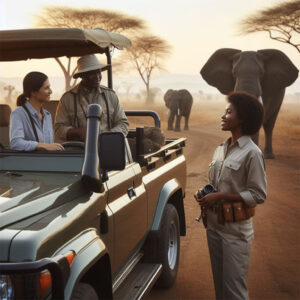
The importance of guiding and tracking is reflected in operating models such as Kwando Safaris, where guide-and-tracker teams remain central to the wildlife experience.
03. More is not necessarily better
More beds can generate more revenue, but scale can also affect exclusivity, vehicle density, service, wildlife encounters and the character of the experience.
The same principle applies to capital expenditure. Spending more on architecture, interiors and hospitality does not automatically produce a stronger asset.
The question is not simply how much can be built or spent, but what level of development is appropriate for the location, market and experience the business can sustainably deliver. The Rules repeatedly caution against allowing physical luxury to compensate for weaknesses in the core safari proposition.
04. Balance creates value
Rule 17 describes the seamless integration of wildlife, hospitality and service as paramount to the quality of a safari business. When these elements operate independently rather than in harmony, overall value can diminish.
This is one of the central ideas running through Some Safari Rules.
A safari business is neither simply a lodge nor simply a wildlife experience. Its success depends on the interaction between the two, together with its people, service, infrastructure, conservation context and commercial model.
The strongest businesses understand that relationship and allocate attention and capital accordingly.
05. Know the market you are serving
A safari business cannot be all things to all people.
Different guests value different experiences, levels of luxury, accessibility, wildlife, privacy and price points. Trying to appeal indiscriminately can weaken the proposition rather than broaden it.
Clear positioning therefore matters. Owners and investors need to understand the market an asset can credibly serve, how it compares with competing experiences and whether its operating model and capital structure support that position.
06. Small decisions can have significant consequences
Many of the 23 Safari Rules concern details: where a lodge is positioned, how guides interact with guests, how many vehicles converge on a sighting, whether night drives are possible, the size of a property and even how a business responds to guest feedback.
Viewed individually, these may appear to be operating decisions.
Viewed together, they influence something much larger: the experience guests remember and the business they choose to recommend, revisit and pay for.
That is why understanding a safari business requires looking beyond any single financial, operational or conservation measure.